Making Space for Rest
I have practised yoga for more than thirty years.
Over that time, the shape of my practice has changed many times.
There have been years when I wanted to move. To learn another posture. To stay longer. To understand more.
Vinyasa has remained an important part of my practice. I still love the feeling of the body moving with the breath, the warmth that gathers through repetition, the concentration that comes from following one movement into the next.
But somewhere along the way, I began making more room for something else.
Rest.
At first, restorative yoga sat around the edges of my practice.
A supported posture at the end of a sequence. A bolster brought out when I was tired. Something I might turn towards after a particularly full day.
Now it has a place of its own.
Most weeks, I practise some form of restorative yoga.
Sometimes twenty minutes is enough.
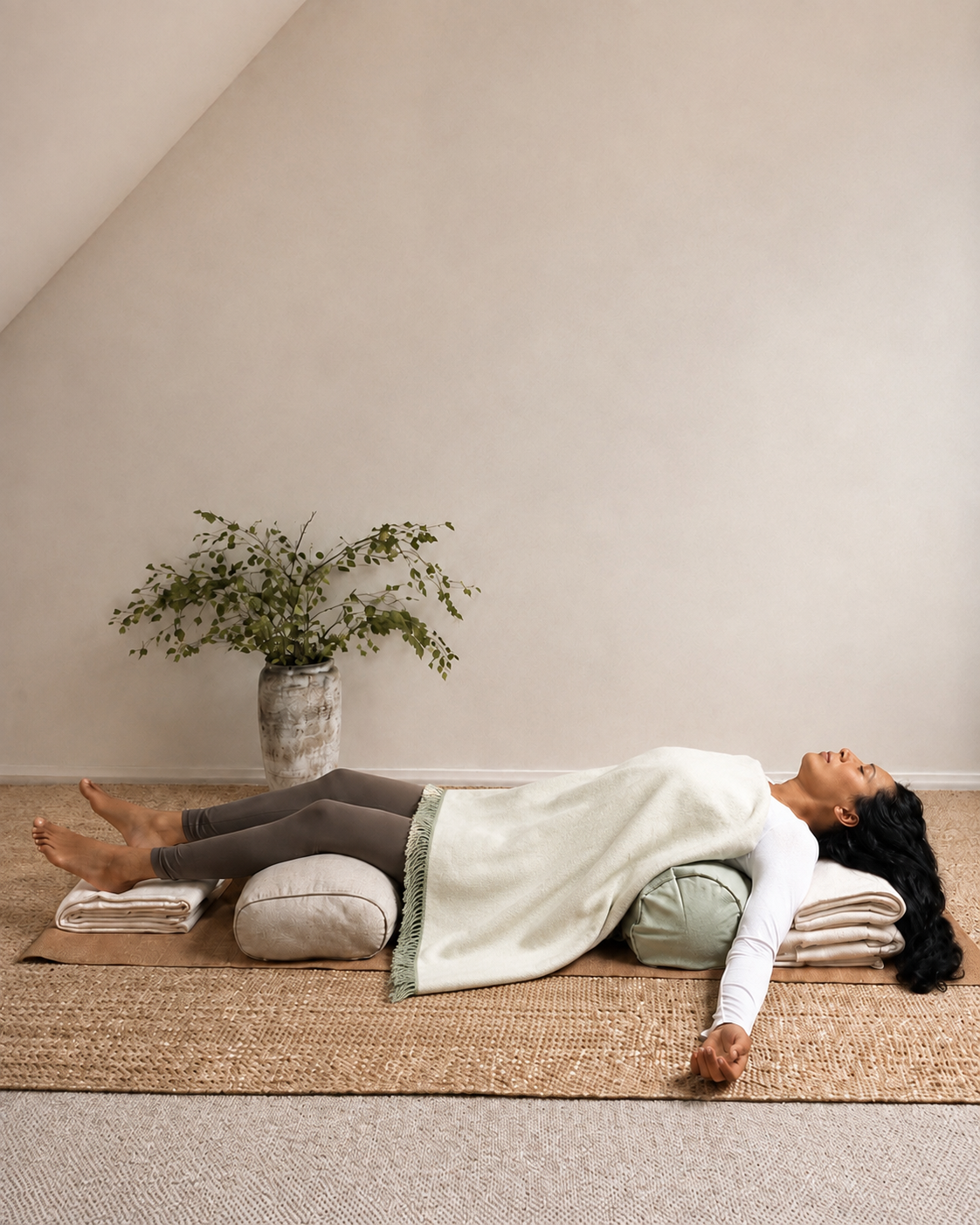
I arrange the bolsters and blankets before I begin. I take time to find the height that allows the body to be held without strain. A folded blanket beneath the feet. Support beneath the knees. Another beneath the head.
Then I lie down.
The first few minutes can still surprise me.
The body does not necessarily become still because I have decided to rest.
I can feel where I am holding.
The jaw.
The shoulders.
The muscles around the eyes.
The breath may still carry some of the pace of the day.
So I stay.
Gradually, the weight of the body begins to meet the support beneath it.
The back softens around the bolster.
The legs become heavier.
The breath changes without being asked to change.
This is one of the things restorative yoga has taught me.
Rest cannot always be hurried.
The body needs time to recognise that it no longer has to hold itself in the same way.
Perhaps this is why restorative practice has become more important to me as the years have passed.
My understanding of progression has changed.
I once thought progress in yoga could be seen most clearly in what the body was able to do.
Now I notice it elsewhere too.
In recognising when effort is useful.
In recognising when it has become unnecessary.
In knowing when movement feels right, and when the body would benefit more from being supported.
In being able to remain still without feeling that I ought to be doing something else.
There are days when I still want the rhythm of a flowing practice.
There are days for standing poses, strength and movement.
And there are days when I place the bolsters on the floor, fold the blankets, and give the weight of my body somewhere to go.
After more than thirty years, restorative yoga has not replaced the rest of my practice.
It has become part of its balance.
Some days the practice asks me to move.
Some days it asks me to stay.
I am learning to listen to both.
Susanna Syassen