Why Yin Yoga Feels Different
Movement and stillness
In a Vinyasa practice, the body moves from one posture into another.
Muscles engage to support us. The breath accompanies the movement. Heat begins to build. There is rhythm and repetition.
I love this way of practising.
But Yin asks something different of the body.
We come into a posture slowly, find an appropriate place to remain, reduce unnecessary muscular effort and stay for longer.
This does not mean that nothing is happening.
Muscle, fascia and other connective tissues form an interconnected structure throughout the body. When we remain in a position, the tissues experience sustained mechanical load rather than the continually changing load of a moving practice. Research into static stretching suggests that both muscle and fascia can respond to sustained stretching, although the science of fascia is still developing.
For me, however, the difference is felt before it needs to be explained.
Time changes the posture.
A sensation that seemed very clear during the first few breaths may alter.
The breath may become easier.
Something may soften.
Or the body may tell me that I have gone far enough.
Learning to hear that difference is part of the practice.
Finding the right place
Yin Yoga is sometimes described as passive.
I don't think that means we simply collapse into a posture and remain there.
There is still discernment.
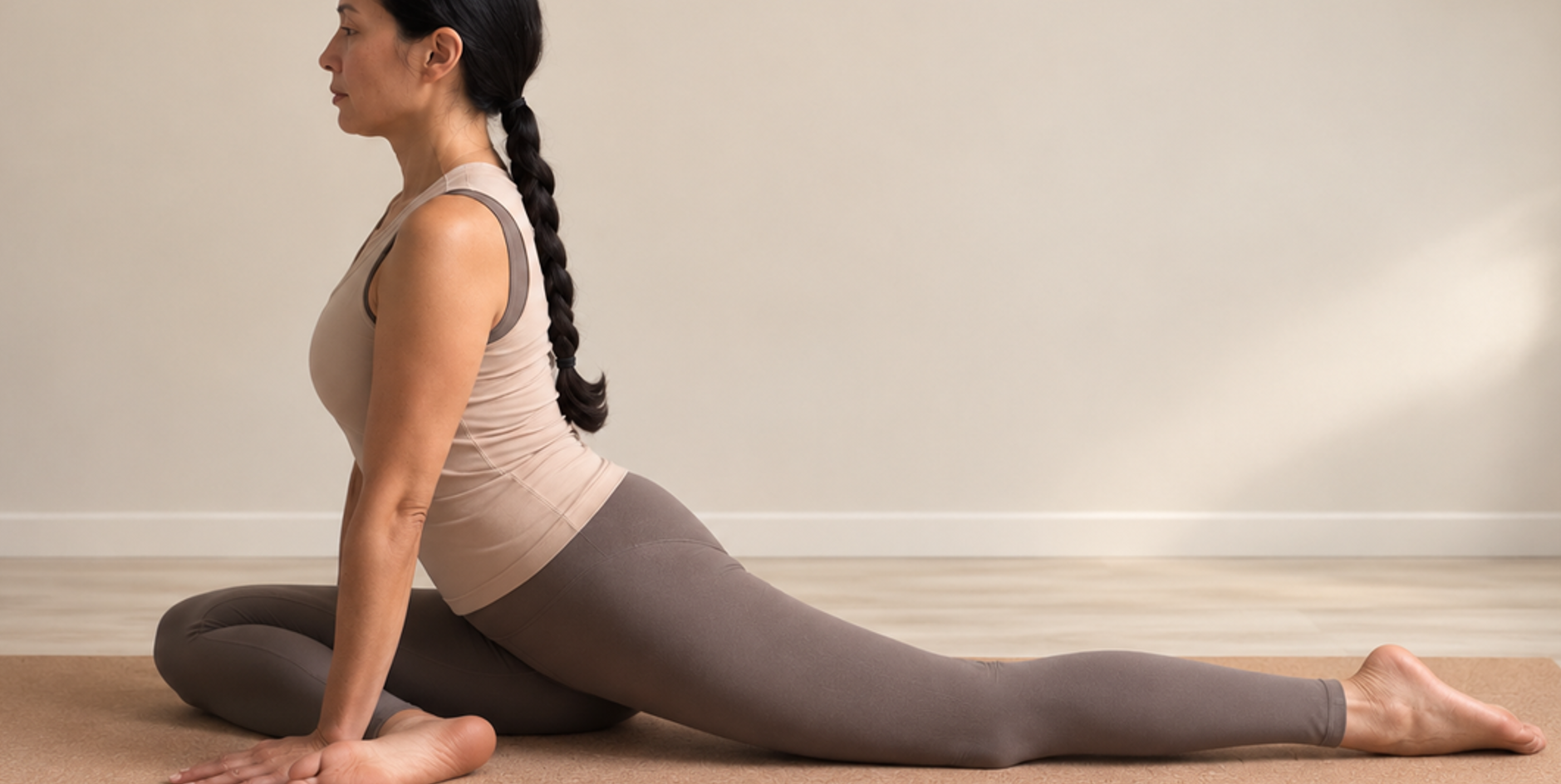
When I come into Swan, I am not looking for the deepest version of the shape my body can make.
I am looking for a place where I can stay.
That place will be different for every body.
Our bones are different. Our joints are different. Our proportions, mobility, injuries, histories and experience are different.
The posture does not need to look the same from one person to another.
And it may not look the same in my own body from one day to the next.
This matters.
A strong sensation is not evidence that a posture is working better.
Pain is not something to breathe through in order to reach a deeper pose.
If something feels sharp, pinching, unstable, numb or simply wrong, I come out or change the position.
Stillness does not mean enduring.
It means staying attentive.
Yin is not Restorative Yoga
Yin and Restorative Yoga can look surprisingly similar from the outside.
Both may use bolsters and blankets.
Both may involve long periods of stillness.
Both give us time to turn our attention towards the body and the breath.
But their intention is different.
In Restorative Yoga, I use support so that the body can give more of its weight away. I am not looking for a meaningful stretch. The bolster, blankets and floor do much of the holding for me.
In Yin, props can also be useful, but I may still choose to remain with an appropriate degree of sensation and load.
The distinction is subtle, but important. Yin Yoga traditionally uses long held postures with reduced muscular effort to create sustained loading, while Restorative Yoga uses greater support and aims to minimise that loading.
One asks me to stay and listen within a posture.
The other gives me somewhere to rest.
I value both.
What time teaches us
Perhaps this is the part of Yin that has become most interesting to me over the years.
When we move quickly, we notice certain things.
When we remain, we notice others.
The first sensation is not always the whole story.
Sometimes I discover that I can soften.
Sometimes I discover that I need more support.
Sometimes the wisest response is to move back.
And sometimes I come out altogether.
This is why I don't think of Yin as simply stretching.
It is a practice of listening.
Body first.
Then breath.
Then the thoughts and reactions that arise when there is nowhere else to go for a few minutes.
We begin to notice the difference between sensation and reaction.
Between effort and habit.
Between staying because the posture feels appropriate and staying because we think we ought to.
That awareness follows us into other forms of yoga.
It follows us into Vinyasa.
Into Restorative practice.
Into Savasana.
And eventually, perhaps, beyond the mat.
Returning to Swan
After several minutes in Swan, I slowly begin to come out.
There is no need to hurry.
I notice the first movement.
The change in pressure.
The feeling of the leg as it lengthens again.
For a moment, I do very little.
I listen to what remains.
This, too, is part of the posture.
Yin Yoga has taught me that a practice does not always deepen by asking the body to go further.
Sometimes it deepens because we give ourselves enough time to feel where we already are.
Susanna Syassen